Imagine watching a tense football game where your team’s quarterback throws a 40-yard bomb deep down the right sideline.
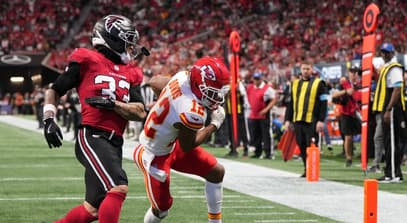
While the ball is in the air, the intended receiver is interfered with by the cornerback, but he still manages to catch the ball near the sideline, getting one foot inbounds before the other touches the white sideline.
If you are watching an NFL game, you hope to see a yellow flag and a 40-yard penalty for defensive pass interference. If you watch a college football game, you can forget the flag and enjoy the 40-yard catch.
Those are just some examples of the most glaring differences in NFL and NCAA football rules. Below, we look at some of the most significant rule differences affecting scoring and outcomes in these leagues.
Differences in Equipment and Clock
Football size and decoration
Believe it or not, not all footballs are created equally. The footballs used in the NCAA are slightly smaller than the NFL balls.
You often hear about the important measurement of a quarterback’s hand size during each NFL Combine because a larger hand will allow the player to get a better grip on the ball, which helps with accuracy and avoiding fumbles.
The college football size is not only smaller but also has white stripes painted on it, unlike the NFL balls. Young receivers making this adjustment to the NFL may be at higher risk for drops early in their careers.
Take the case of Cincinnati Bengals wide receiver Ja’Marr Chase, who is an outstanding player but had more than 20 drops across his first two seasons in the NFL.
Chase told Bengals.com that the NFL ball is more challenging to catch without those stripes visible to the receiver.
“It doesn’t have the white stripes on the side so you can’t see the ball coming from the tip point so you actually have to look for the strings on the ball at the top, which is hard to see because whole ball is brown and you have the six strings that are white. But for the most part, just have to get used to it and find out what I am comfortable with catching”.
Clock Stoppages in Final Two Minutes
For decades, one of the most significant differences in NCAA vs. NFL rules was that the college clock would stop momentarily to reset the chains after gaining a first down. This explains why college games usually have longer and higher scoring than NFL games.
The average game in the 2022 NFL season was 3 hours and 3 minutes with 43.8 combined points.
The average game in the 2022 NCAAF season was 3 hours and 27 minutes with 54.8 combined points.
But in 2023, the NCAA is aligning with the NFL, allowing the clock to continue running on first downs. However, the clock will still stop after the first downs inside the final 2:00 of both halves, which is an excellent advantage to the offense.
The only mandatory clock stoppage in the NFL is the two-minute warning in each half, which the NCAA does not utilize.
Differences in Catches and Down by Contact
Sometimes to fans’ bemusement, what counts as a catch and down by contact depends on which league you are watching.
Sometimes, to fans’ bemusement, what counts as a catch and down by contact depends on which league you are watching.
Number of Feet Down for a Catch
Not only do college receivers have a smaller ball with stripes on it to catch, but they only need to get one foot down inbounds for the play to count as a completion, per college football rules.
For the last two decades, the NFL rules have made it very hard to determine what a catch is, with fans often left bewildered on plays such as Dez Bryant (2014 Dallas Cowboys vs. Green Bay Packers in the playoffs) or Jesse James (2017 Pittsburgh Steelers vs. New England Patriots).
The main difference is that the NFL requires two feet (or an equivalent, such as your butt or knee) to be down, while the NCAA is fine with one foot.
This naturally will lead to more catches being made in college. This doesn’t translate to the NFL, though, as sometimes the quarterback’s accuracy is off, making it physically possible for the receiver only to get one foot down.
However, most young college receivers with NFL aspirations will display the ability to get both feet down. Perhaps the NCAA will consider upgrading to the NFL rule to make two feet universal.
Down by Contact
One difference that favors offense in the NFL is that ball carriers can get up and run if not touched down. In college, a player is ruled down by contact if any body part other than their hands or feet touches the ground.
A poorly thrown ball a player catches on his knees in college will automatically end the play. But in the NFL, that player can still get to their feet and run until they are tackled.
This is why coaches get angry when an NFL defender does not tap a player down just to be sure the play is over.
Differences in Defensive Penalties
Defensive Pass Interference
Most football penalties are between 5 and 15 yards, but defensive pass interference (DPI) in the NFL can be worth over 50 yards or as far as your quarterback can throw, making it the biggest penalty in the league.
It is a spot foul and automatic first down. If the DPI occurs in the end zone, the ball is placed at the 1-yard line.
In college, DPI is a spot foul with a maximum of 15 yards rewarded to the offense. Even if a player interferes with 50 yards down the field, the penalty will be only 15 yards, which gives a defensive back an incentive to pull a receiver down if he knows he is beaten deep for a touchdown.
The penalty is much less severe in the NCAA.
Illegal Contact
The NFL has enforced the illegal contact rule as “The Mel Blount Rule” since 1978.
This prohibits defenders from forcibly contacting a receiver more than 5 yards down the field before the pass is thrown. It is a 5-yard penalty and automatic first down.
However, in the NCAA, illegal contact does not exist. You can contact receivers past five yards, all the way downfield, as long as the ball has yet to be thrown.
Once the ball is in the air, any contact with a receiver would be deemed defensive pass interference.
This certainly makes playing defensive back tougher in the NFL, as that ability to jam a receiver is crucial to throwing off the timing of the route.
Troubled corner Eli Apple, a 2016 first-round pick, has twice led the NFL in defensive pass interference penalties, including his 2021 season with Cincinnati, where he was flagged for interference in the end zone two plays before Cooper Kupp’s game-winning touchdown.
This might explain why Apple, who NFL.com draft analyst Lance Zierlein referred to as “Mr. Grabs” in his scouting report, is on his sixth NFL team in 2024.
List of Other Rule Differences
Finally, here is a list of some other noteworthy rules or procedural differences between the leagues:
Any play in the NCAA can be reviewed from the booth, while NFL coaches have two challenges. Only scoring plays or turnovers are automatically reviewed.
College games cannot end in a tie, but NFL games can. There have been 29 tied games in the NFL since 1974.
NFL games are highly competitive, with about 70% being within one score in the fourth quarter during the 2023 season, leading to the possibility of overtime.Overtime rules differ between regular season and postseason, with the regular season featuring a 10-minute period where the first team to score a touchdown wins, while postseason games continue with multiple periods if necessary to determine a winner.NCAA overtime allows each offense to start at the opponent’s 25-yard line and alternate possessions until someone wins.
Starting in the third overtime, teams must attempt a 2-point conversion. 2-point conversions are attempted from the 2-yard line in the NFL and from the 3-yard line in the NCAA, making it harder in college to convert.
The NCAA has a targeting rule for illegal hits that results in automatic game ejection. The NFL penalizes particular illegal hits, but ejection is not mandatory, and no specific targeting rule exists.
As of 2022, defensive holding penalties in the NCAA carry a 10-yard penalty and automatic first down (instead of replaying the down). They remain 5-yard penalties and automatic first downs in the NFL.
Our best football betting sites
To make sure you get the most value on your NFL odds, go to the best NFL betting sites prior to placing your wagers throughout the season.
Andy is a sports writer and content creator specializing in performance data and analytics. He is also one of the UK’s top football coaches, leading a top-5 ranked team. He regularly appears in local and national media covering the UK’s fastest-growing sport. Though football is his primary passion, Andy has experience in college basketball, pro basketball, and MLB. With a degree in Film and Media, he has a rich background in digital communication and marketing. Andy excels at creating intelligent, data-driven content that entertains and informs bettors, with his work quoted in Sports Illustrated and Newsweek. His analytical approach to betting mirrors his content creation, ensuring well-supported perspectives and predictions.
NFL coaches are already facing pressure as the 2026 season gets underway. We break down the latest next NFL coach fired odds, including the coaches drawing the most attention after the midway point of the season.
The NFL MVP odds market for the 2026 season is heating up. Bengals QB Joe Burrow leads the way in odds to win NFL MVP, followed by Josh Allen and Brock Purdy.
The defending champion Seattle Seahawks had the fourth-best Super Bowl odds to open the 2026 season. Find out who's at the top and the other contenders.
Breaking down Heisman Trophy odds for the 2026 college football season, including leading quarterbacks, breakout candidates, and shifting betting markets as performances and narratives evolve now.
Seven FBS coaches have been fired in 2026, including Mike Norvell, Scotty Walden, and Butch Jones. With the coaching carousel spinning fast, our next college football coach to be fired odds have a new favorite.
Looking for the best NFL Week 11 props? We break down five player prop betting picks, including anytime TD predictions for Brenton Strange and George Pickens.
Find printable NFL Pick'em sheets for every week of the 2026 season. Download weekly pick sheets, predict game winners, organize office pools, and track your selections throughout the NFL season with ease.
Get our NFL Pick'Em Week 11 predictions for every matchup on the Week 11 schedule. We break down key matchups, best picks, and potential upsets to help you gain an edge in your pool.
The NFL 2026 schedule is here with every regular-season game, primetime matchup and international contest. See the complete week-by-week list from kickoff through Week 18.
The NFL International Games 2026 schedule features every matchup outside the United States, including London, Mexico, Brazil, Australia and other global destinations.
We use cookies to ensure you get the best experience on our website. You can manage your preferences and find out more by clicking the ‘Customise’ button below.